
Collision Avoidance
Applying the vector triangle: closest point of approach, target's true course/speed, course to pass at a specified CPA. (Pub 1310 Ch.3)
1 · Closest Point of Approach (CPA)
The CPA is the perpendicular distance from your ship (the screen center) to the target's relative movement line — the closest the target will pass if no one maneuvers. To find it on the reflection plotter:
- Plot at least three relative positions (
M₁ M₂ M₃); confirm they fall on or very near a straight line. - Extend the RML past the center of the PPI.
- Crank the variable range marker (VRM) until its ring is tangent to the RML. The point of tangency is the CPA.
- The VRM reading gives range at CPA; the bearing cursor through the tangent point gives bearing at CPA.
Pub 1310 specifies that you re-construct the RML if the contact stops plotting on the original line — that means the target has maneuvered (or the wind/current has shifted you off your assumed course) and the previous solution is invalid.
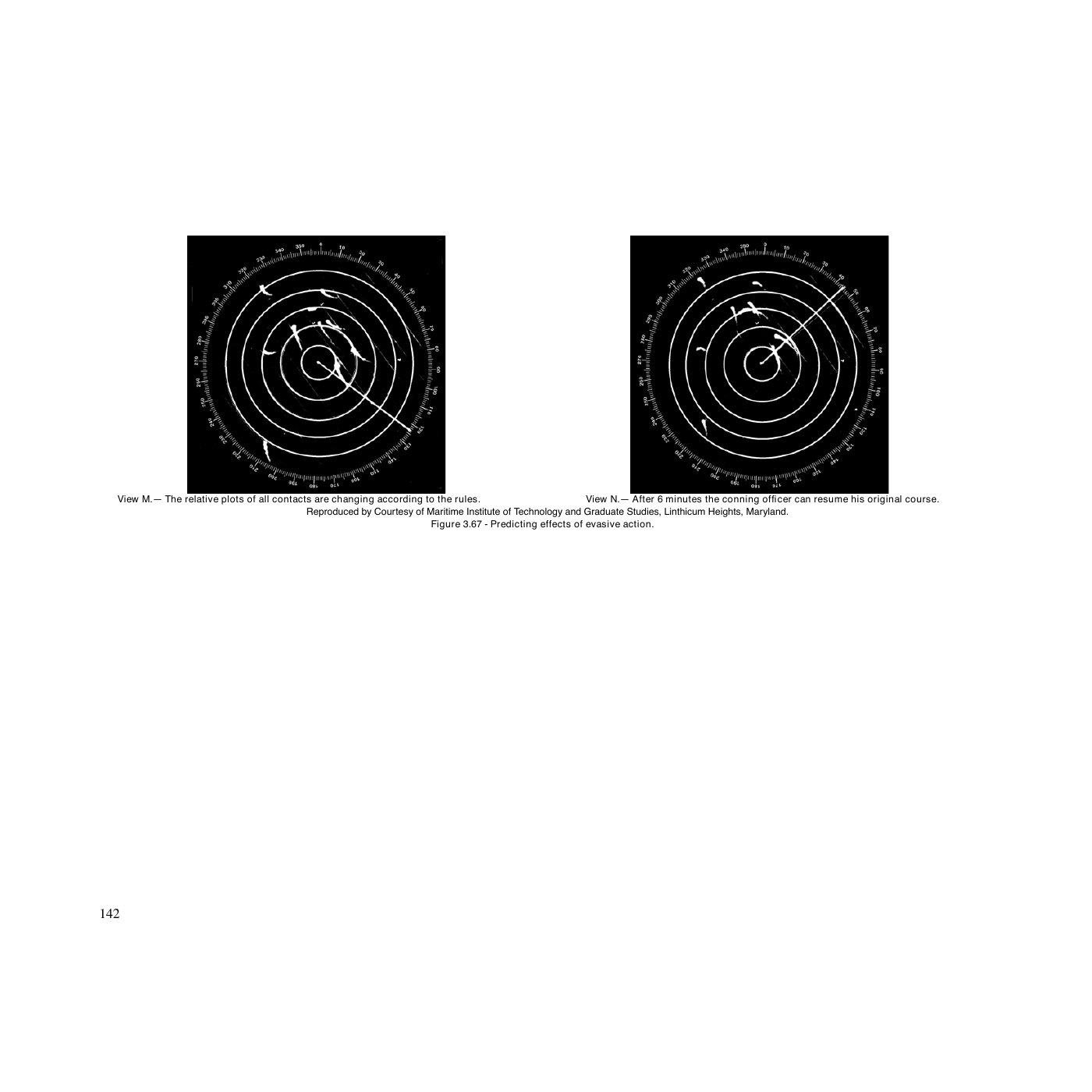
The companion measurement is TCPA — time to CPA. From the SRM and miles-of-relative-movement still to traverse: TCPA (minutes) = (distance from M₃ to CPA, in nm) / SRM × 60. Or read it directly off the maneuvering board's nomogram.
2 · The target's true course and speed
From the relative motion alone you only know the DRM and SRM. To get the target's true course and speed (which is what you need to plan an evasive course), construct the vector triangle:
- From
M₁(or any chosen relative position), lay off your own ship's true vectorerin the opposite direction of your course, length proportional to your speed (1 knot per chosen length-per-knot unit). - The relative vector
rmgoes along the RML in the directionM₁ → M₂ → M₃, length = SRM × plotting interval. - Close the triangle: from the tail of
er(which is pointe) to the tip ofrm(which is pointm). That closing line isem— the target's true vector. - Direction of
em= target's true course. Length ofem= target's speed.
This step is what the human plot adds over what the screen shows — the screen alone cannot tell you whether the target is a fast container ship overtaking you or a slow trawler crossing your bow. The vector triangle does.
3 · Course to pass at a specified CPA
Suppose CPA in the current geometry is 0.5 nm and you want at least 2 nm. The construction:
- Decide a desired CPA — say 2 nm. Draw a circle of that radius around your ship (the screen center).
- From
M₃(or whatever the latest plot is), draw a tangent to that circle on the side you want to pass — typically port or starboard depending on COLREGS rules and traffic. This tangent line is your new desired RML. - Now find the new own-ship vector
er'that produces this new RML. The target's true vectoremdoesn't change (you can't make them maneuver). So:r' = m − rm', whererm'is parallel to the new desired RML and at the new SRM. - The new
er'direction = your new course; the length = the speed needed to achieve it.
In practice you usually pick a course change at constant speed (turn 20° to starboard, hold speed) and read out the resulting CPA, rather than solving for a specific CPA. The maneuvering board makes either approach equally fast.
Slow-down option. Alternatively, hold your course and reduce speed. Same triangle, different unknown: er' shrinks but keeps the same direction; the new rm' closes to a different RML. Sometimes a simple speed reduction does what a course change would do, with less disruption.
4 · Special cases
Three configurations come up often enough that you should be able to recognize them at a glance:
- Target dead in the water. Its true vector
emhas zero length, soe = m. The relative vectorrmis exactly opposite your own true vectorer. A static buoy or stopped ship's relative track on your PPI mirrors your own course. - Target on parallel course at the same speed. Its true vector equals yours:
em = er, so the relative vectorrm = 0— zero motion. The target is a fixed dot on your screen at constant bearing, constant range. Not a collision course — but you'll be in formation indefinitely if neither maneuvers. - Target on collision course. The RML passes through the screen center — the relative vector
rmpoints directly at you. Bearing remains constant, range decreases. CPA = 0. Time to CPA = current range / SRM.
5 · Multiple-contact discipline
In traffic, several contacts may need to be tracked simultaneously. The book recommends:
- Plot all contacts at the same times — synchronize so you can compare CPAs side by side.
- Prioritize by TCPA (least time first), not by CPA (closest distance). A close-pass distant contact is less urgent than a less-close imminent contact.
- Before maneuvering, check the new geometry against all tracked contacts — a course change that opens CPA on contact A may close CPA on contact B.
- Discrete maneuvers, not continuous adjustment. Pick a course, hold it, replot, evaluate. Wandering courses confuse other ships' plotters.
6 · What modern radars do automatically
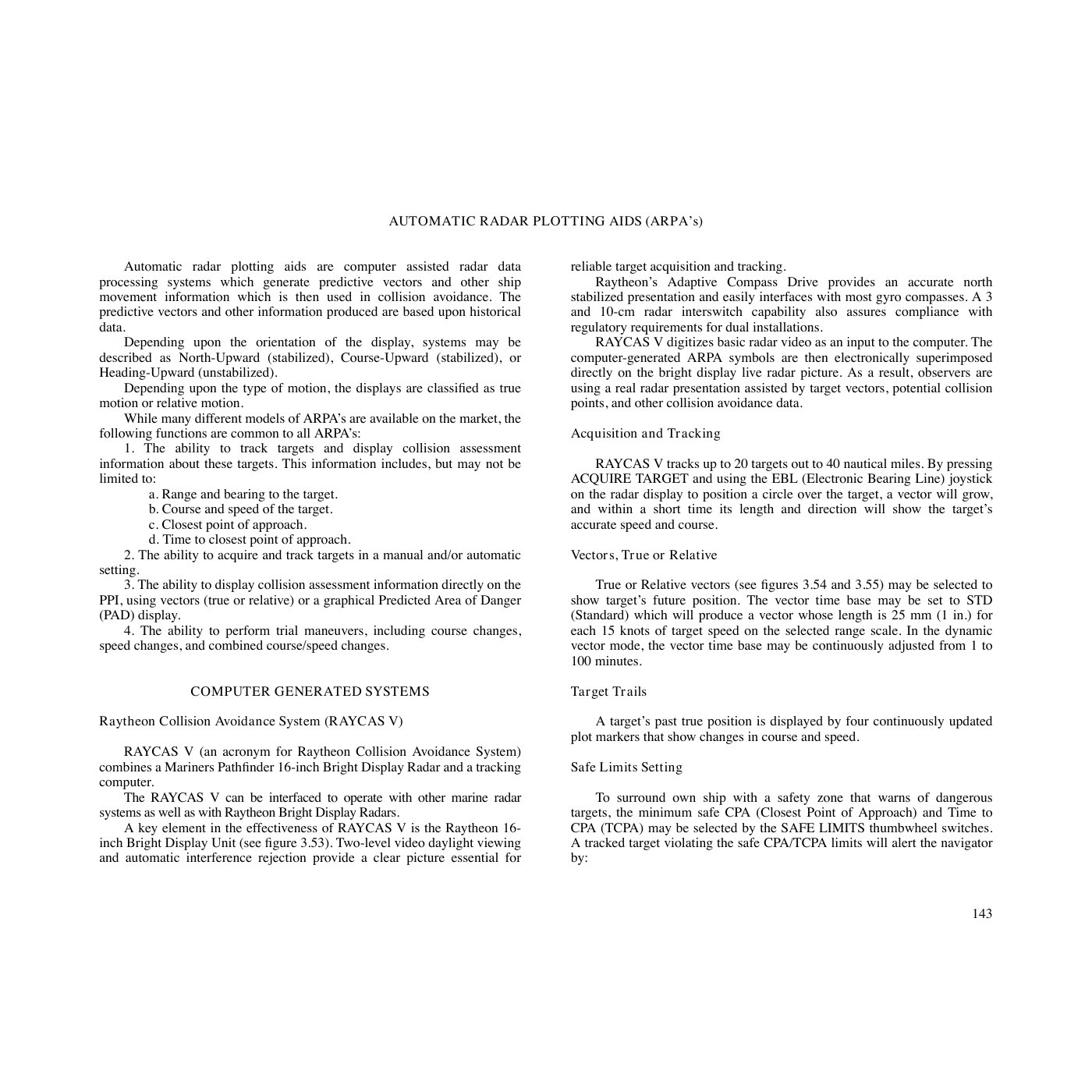
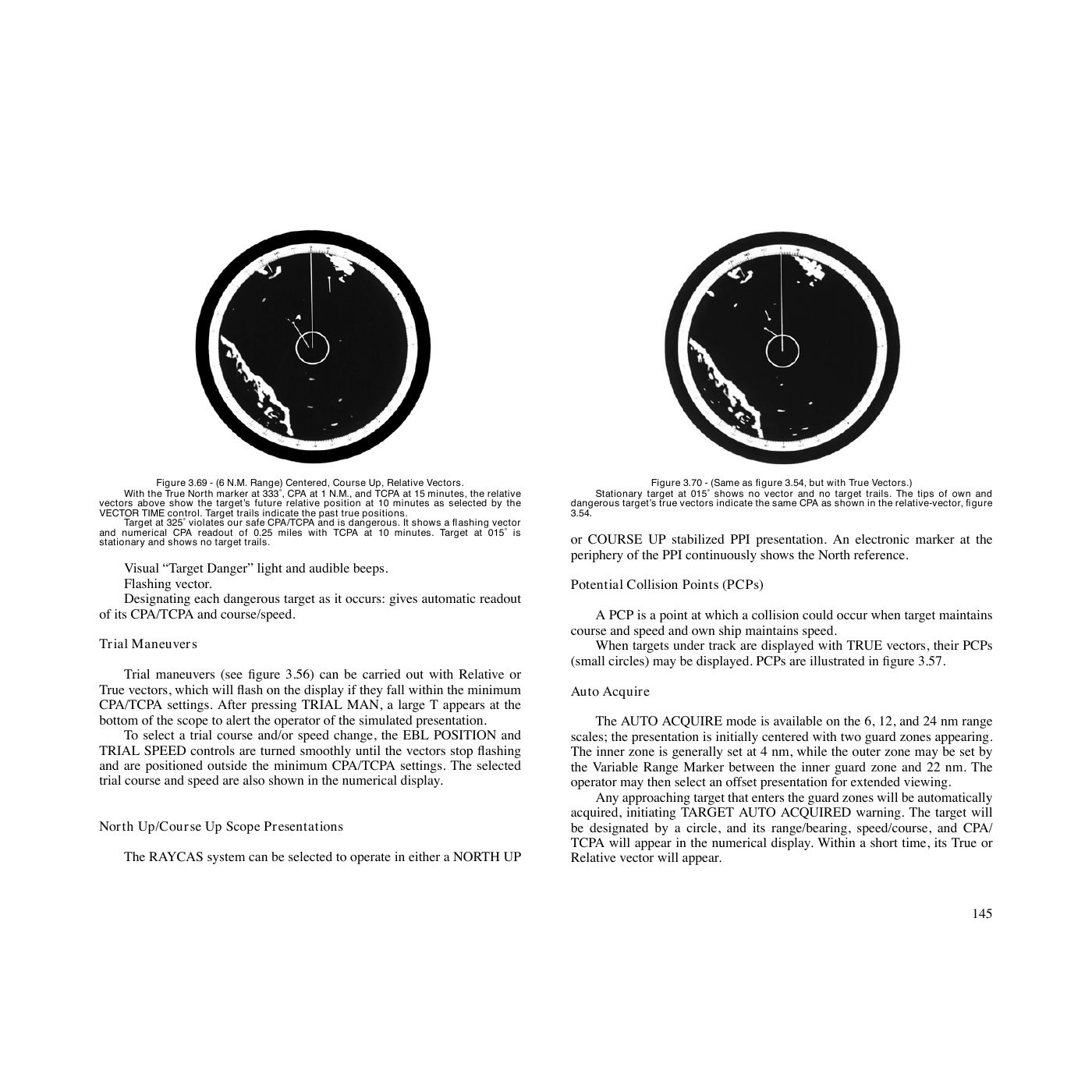
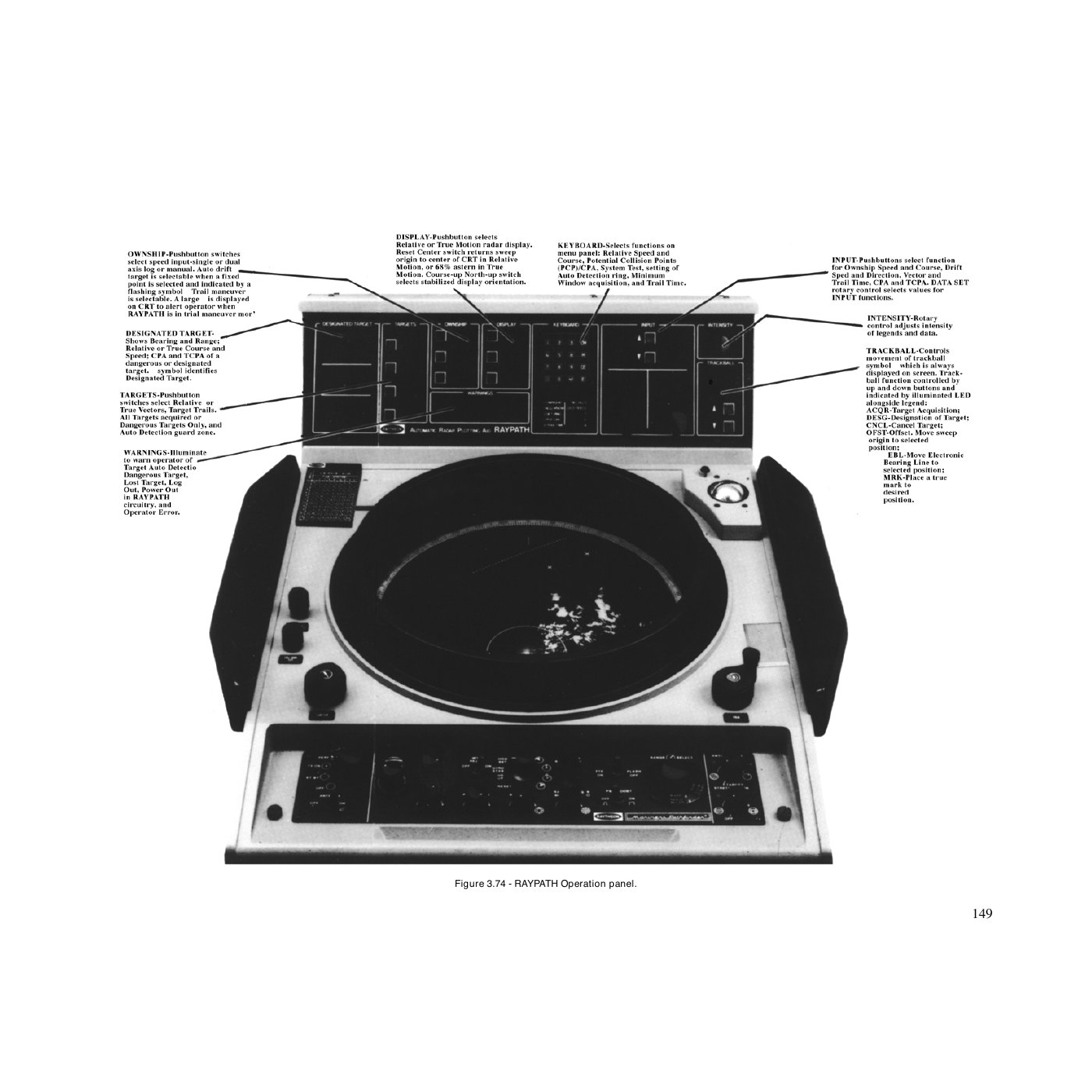
The work above is what an ARPA (Automatic Radar Plotting Aid) does for you: it tracks targets continuously, computes CPA / TCPA / true course / true speed, and displays them as numbers next to each acquired target. Better implementations let you "trial" a maneuver — type a proposed new course/speed, see the predicted CPAs update for every tracked target.
Even with ARPA, the manual skill matters because:
- The ARPA needs a stable course and speed input from your gyro/log to track correctly. If your inputs are bad, its outputs are wrong — and a hand plot is the only way to catch this.
- It can lose track of a target during heavy clutter, near land echoes, or if you maneuver. Knowing the math means you can plot through the gap.
- Small-craft radars (no ARPA) are still common in cruising — most under-50ft sailboats have basic radars without target tracking.
- You can be required to demonstrate manual plotting on your radar observer endorsement exam.
Practical takeaways
- 3 plots minimum, 6-minute interval, then act. Don't maneuver on 2 plots — you may be reacting to noise.
- CPA tangent + VRM is the 30-second answer. Even without finishing the vector triangle, the tangency check tells you whether you have a problem.
- Maneuver early, maneuver large. A 10° turn at 5 nm is invisible on the other ship's plot; a 20–30° turn made decisively at the same range is unambiguous and safe. The COLREGS specifically warn against small successive maneuvers.
- Slow down counts as a maneuver too. Often less disruptive than a course change in heavy traffic, especially if you're the give-way vessel and the stand-on vessel is doing nothing.
- Re-plot after every maneuver. Yours or theirs.