
Radar Plotting
Relative motion, the vector triangle, and the maneuvering board — the math that makes a paint into a course/speed/CPA. (Pub 1310 Ch.3)
1 · Why plot
A radar paint by itself tells you a target is somewhere — at that bearing, that range, right now. Three measurements at three known times tell you something far more useful: the target's direction of relative movement (DRM) and speed of relative movement (SRM), plus everything that flows from them — the closest point of approach (CPA), the target's true course and speed, and any course-to-pass maneuver you can make.
Modern ARPA radars and integrated chartplotters do this math automatically. But the math is what they're doing, and learning it by hand is the only way to (a) sanity-check the box's output, (b) plot manually if the ARPA is unhealthy, and (c) understand why two ships with similar radar pictures may need very different responses.
2 · Relative motion: what the screen actually shows
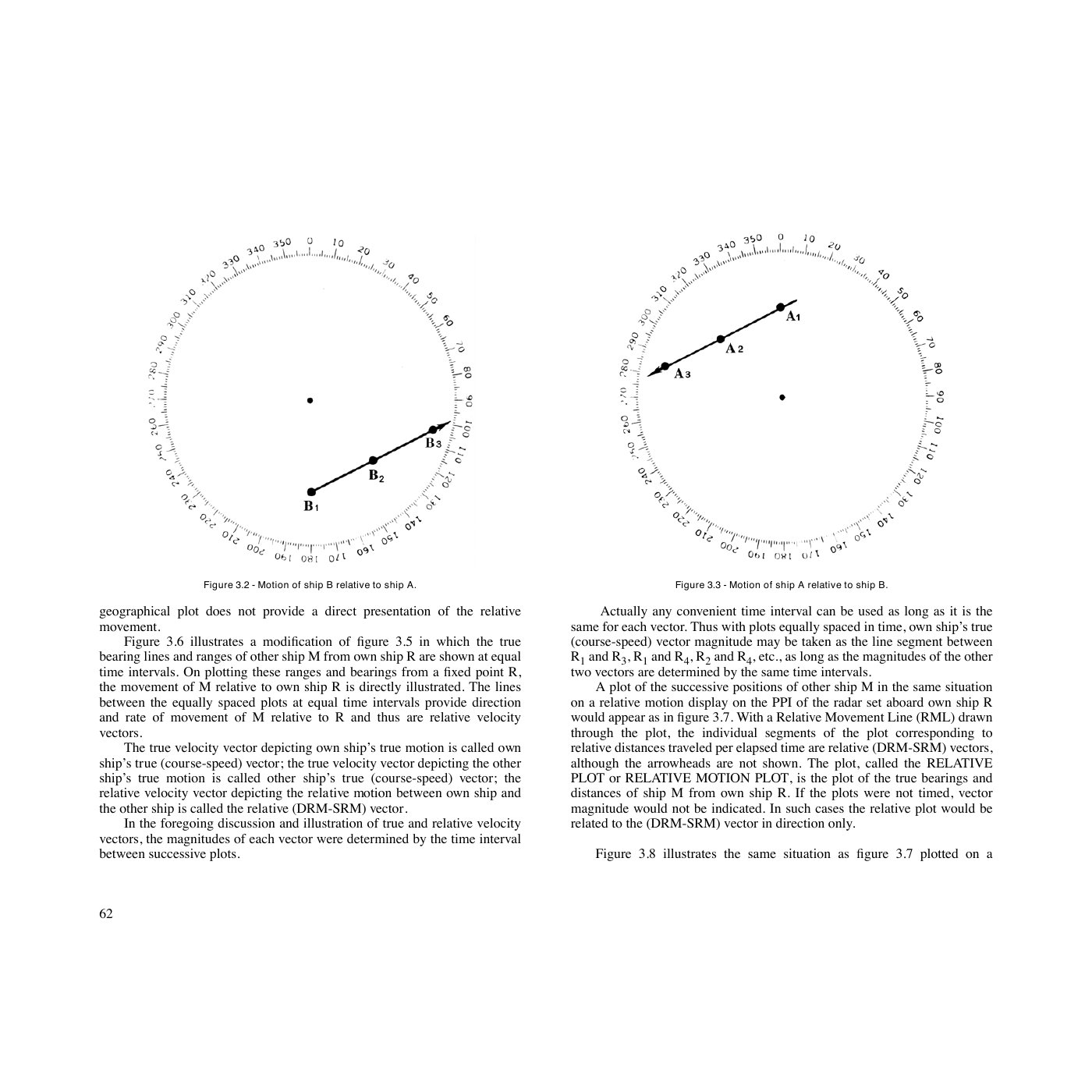
In a relative-motion display your ship is fixed at the center of the PPI. Everything else moves on the screen — including stationary objects like buoys (because you are moving past them). When a target paints at successive positions, the line connecting those positions is the relative movement line (RML).
The RML is the projection of both ships' true motions onto your screen. Two ships on parallel courses at the same speed paint as a single bright dot — zero relative motion, even though both are moving over the ground at 12 knots. Two ships on a perfect collision course paint a relative track radially inward toward the screen center — the bearing stays steady while the range decreases. Bearing-stays-steady-while-range-decreases is the textbook collision-course signature.
3 · The vector triangle
Three vectors live on every plot — they form a closed triangle whose sides each have a precise meaning:
er— your true vector. Origine(the earth, by convention the center of the maneuvering board), tipr. Length = your speed; direction = your course.em— the target's true vector. Same origine, tipm. Length = target's speed; direction = target's course.rm— the relative vector. Goes fromrtom. Length = SRM; direction = DRM. This is what your PPI shows you.
The fundamental identity: em = er + rm (the target's true motion is your true motion plus the relative motion you observe). Re-arranged: rm = em − er (the relative motion is the target's true motion minus yours). Every plotting solution is a different unknown in that triangle.
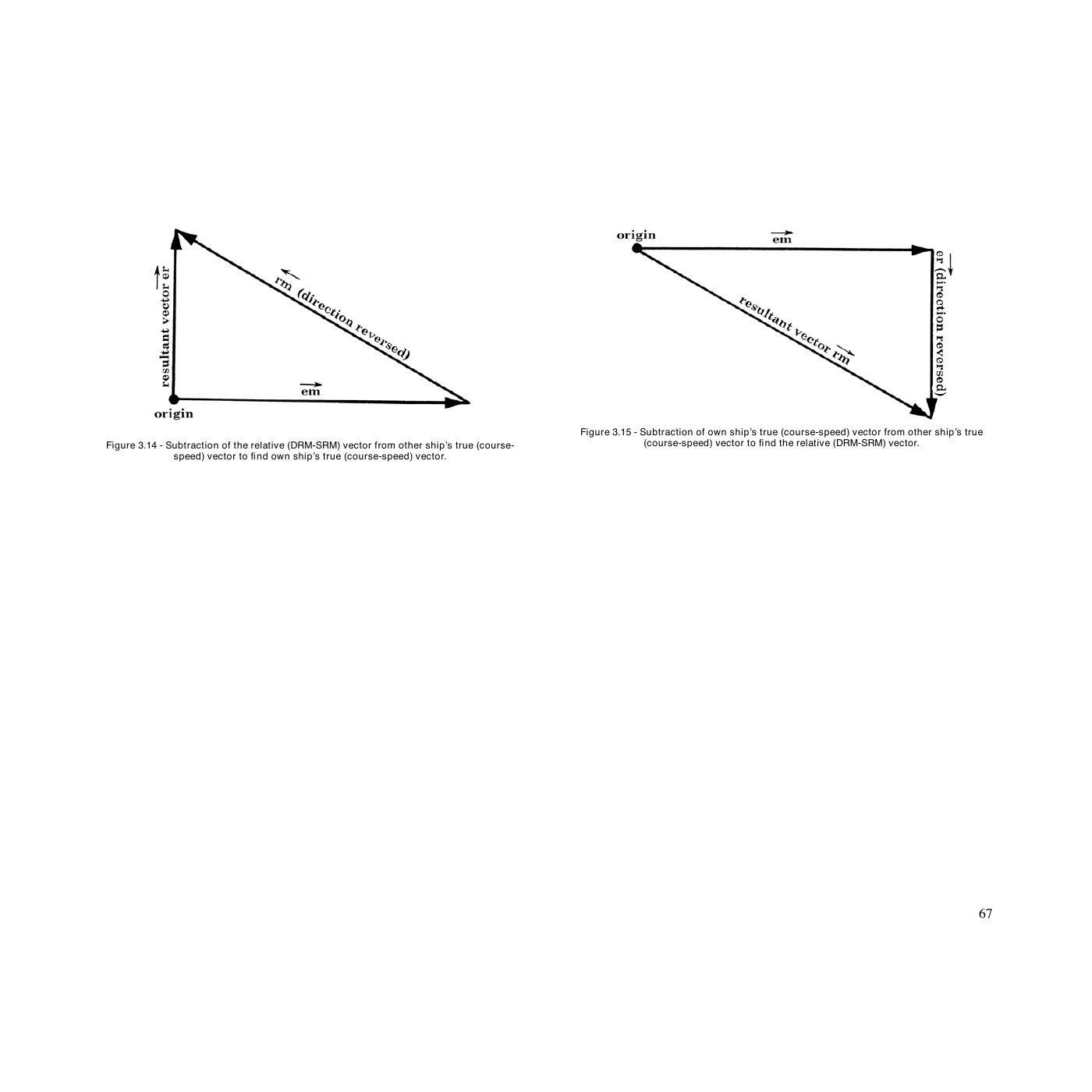
Length per knot is a free choice. If you plot for 6 minutes (= 0.1 hour) then 1 knot of speed = 0.1 nm of vector length. If you plot for 3 minutes, 1 knot = 0.05 nm. The book defaults to 6-minute plots because the math is mental: a vector that's 1.2 nm long over 6 minutes is 12 knots.
4 · The maneuvering board
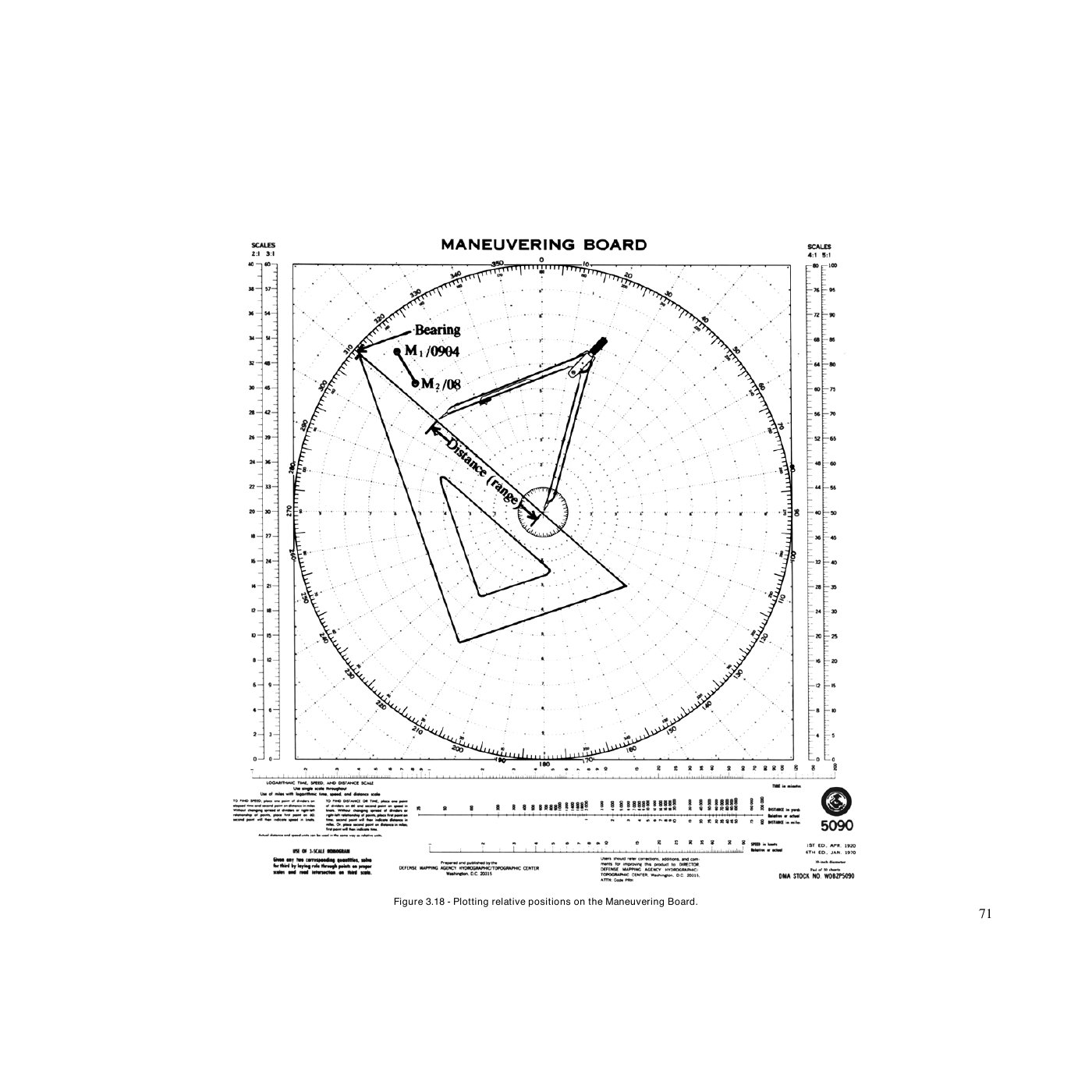
A maneuvering board is a pre-printed sheet with a polar grid (concentric range circles, radial bearing lines), three speed-scale rulers along the bottom, and reference triangles. You plot on it with a pencil and a parallel rule. It's a purpose-built calculator for the vector triangle.
The standard layout:
- Center = your ship (origin
efor the true plot; you for the relative plot). - Range circles at every 2 units of distance, in 10 concentric rings. Pick the scale that suits your situation: 10 rings = 10 nm for an offshore plot, or 10 rings = 2 nm for harbor.
- Compass rose around the outside, in degrees true.
- Three nomograms (speed scales) along the bottom — convert between distance, time, and speed at standard rates.
5 · The standard plotting period
Pub 1310's worked examples use a 6-minute plotting interval: take a target's bearing and range every 6 minutes, mark M₁, M₂, M₃ on the plot. With this interval:
- 1 knot of speed = 0.1 nm of vector length per interval (so a 12-knot ship's true vector is 1.2 nm long over 6 minutes).
- 10 minutes can be substituted as a 1:1 mapping if you prefer (1 knot = 1/60 nm per minute × 10 = 0.166 nm) but mental math is uglier.
- Three points are the working minimum to confirm the target is on a steady course (three points on or very near a straight line). If they're not, the target is maneuvering and any solution is provisional.
6 · Plotting symbols cheat sheet
The convention used across Pub 1310 — match this when reading any worked example:
| Symbol | Meaning |
|---|---|
R | Own ship |
M | Other ship |
M₁ M₂ M₃ | Plotted positions of other ship at successive times |
Mₓ | Position of other ship on RML at planned time of evasive action |
RML | Relative movement line — through M₁ M₂ M₃ |
NRML | New relative movement line (after a maneuver) |
DRM | Direction of relative movement (along the RML) |
SRM | Speed of relative movement |
MRM | Miles of relative movement |
e | Origin of any true (course-speed) vector — fixed w.r.t. earth |
r | End of own ship's true vector er; origin of rm |
m | End of other ship's true vector em; end of rm |
er | Own ship's true (course-speed) vector |
em | Other ship's true (course-speed) vector |
rm | Relative (DRM-SRM) vector — what your PPI shows you |
r₁ r₂ | Ends of alternative true vectors for own ship (when planning a course change) |
CPA | Closest point of approach |
7 · Two plotting techniques
Pub 1310 spells out two equivalent methods that produce the same answers — pick whichever your hands are faster with:
- Maneuvering-board method — plot bearings and ranges as polar coordinates on a fresh maneuvering board. Vector triangle constructed there. Best for taking your time and producing a clean record. Good for traffic separation analysis or post-incident reconstruction.
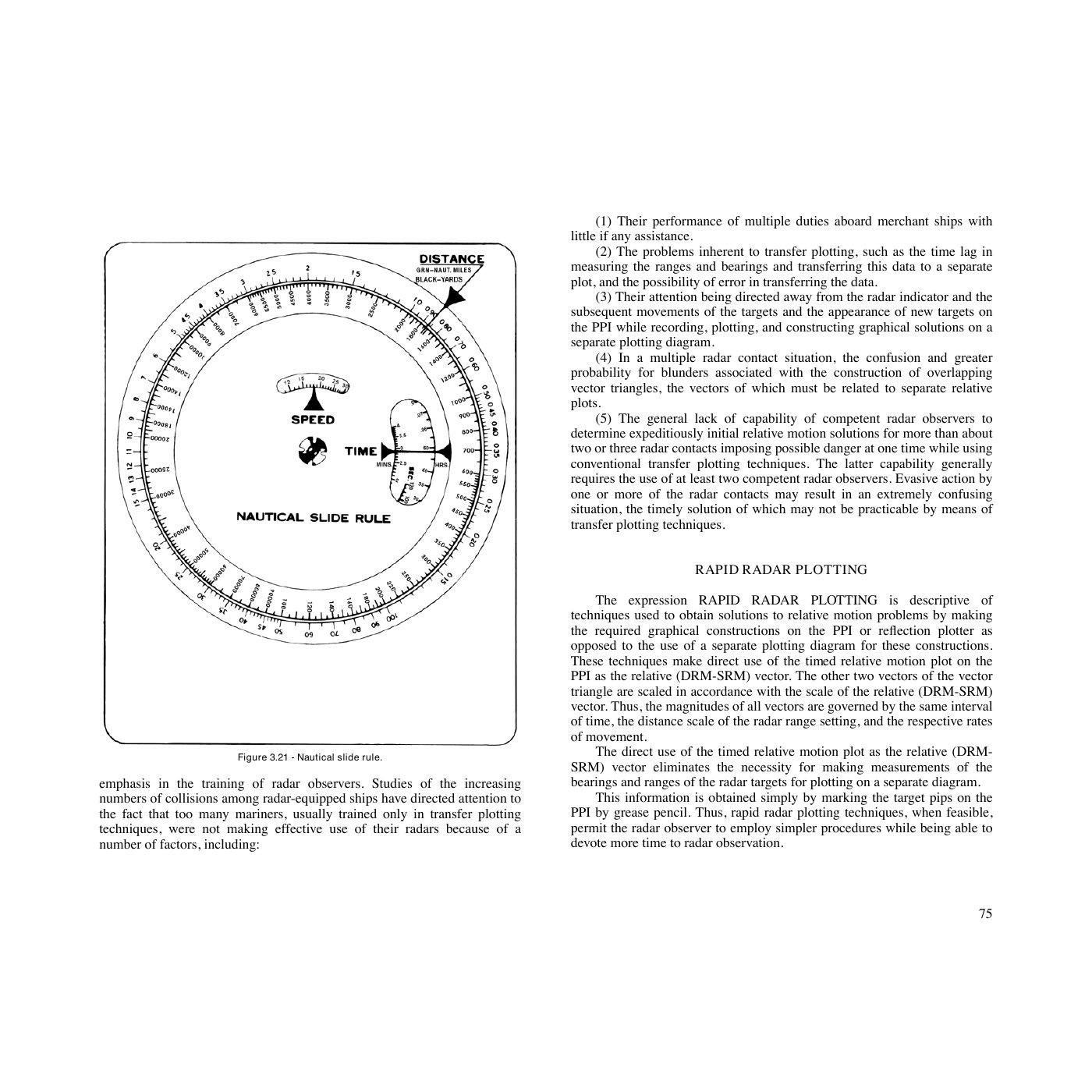
- Rapid radar plotting — plot directly on the reflection plotter glass over the PPI. Use the time between plots and the on-screen distance to scale vectors. Faster but less neat. The working method for active collision avoidance underway.
Practical takeaways
- Always 3 points. Two points give you a line but no confidence the target is on a steady course; three points confirm it.
- 6-minute interval is the sweet spot for handheld plotting — fast enough to act on, slow enough to draw cleanly.
- Steady bearing, decreasing range = collision. No plot needed to spot it; just watch the EBL.
- Replot after any maneuver. Yours or theirs. The old RML is dead the moment a course change happens; you need three new fixes to build a new one.