
COLREGS for radar
The five rules that explicitly govern what radar tells you and what you must do about it. Excerpts from the official rule book with commentary.
These five rules — 5, 6, 7, 8, and 19 — are the radar-specific subset of the COLREGS. They tell you when you must use radar, how to use it, what counts as risk of collision, what counts as a proper avoiding action, and what changes when visibility is restricted. Read together they are the legal framework around the plotting math from the previous two pages. The full Navigation Rules PDF is in References.
Rule 5 · Look-out
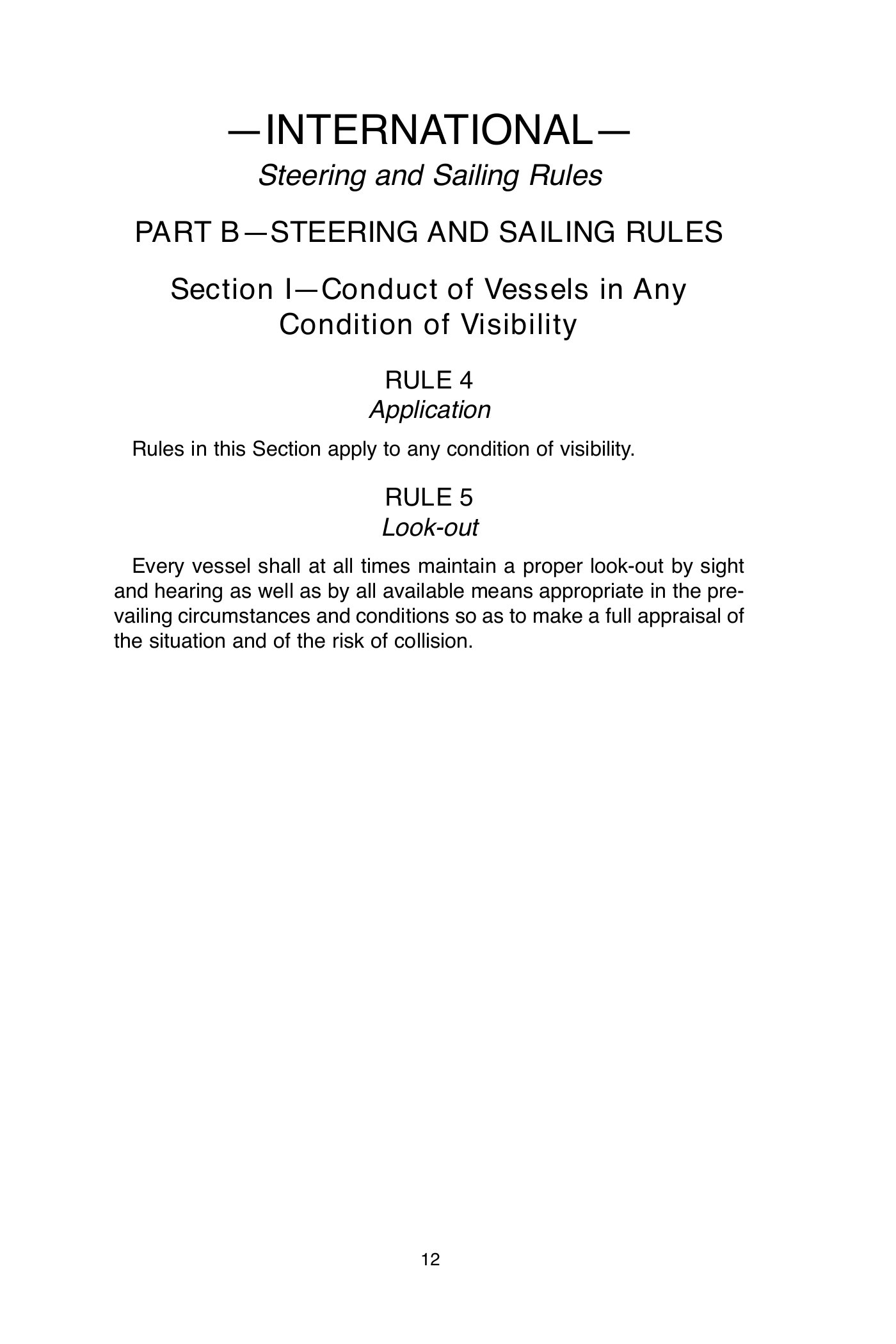
Every vessel shall at all times maintain a proper look-out by sight and hearing as well as by all available means appropriate in the prevailing circumstances and conditions so as to make a full appraisal of the situation and of the risk of collision.
"All available means" includes radar. If you have a radar and don't use it when conditions warrant — at night, in fog, in heavy traffic — you are in violation of Rule 5. Conversely, radar is not a substitute for visual look-out: it supplements it. Both/and, not either/or.
For small craft this means: switch the radar on for any night passage in any traffic area, any fog, and any approach to a port. The convention isn't "I only need it if visibility is poor"; it's "I have a tool that finds targets I might not see — I am required to use it."
Show original rule page
Rule 6 · Safe Speed
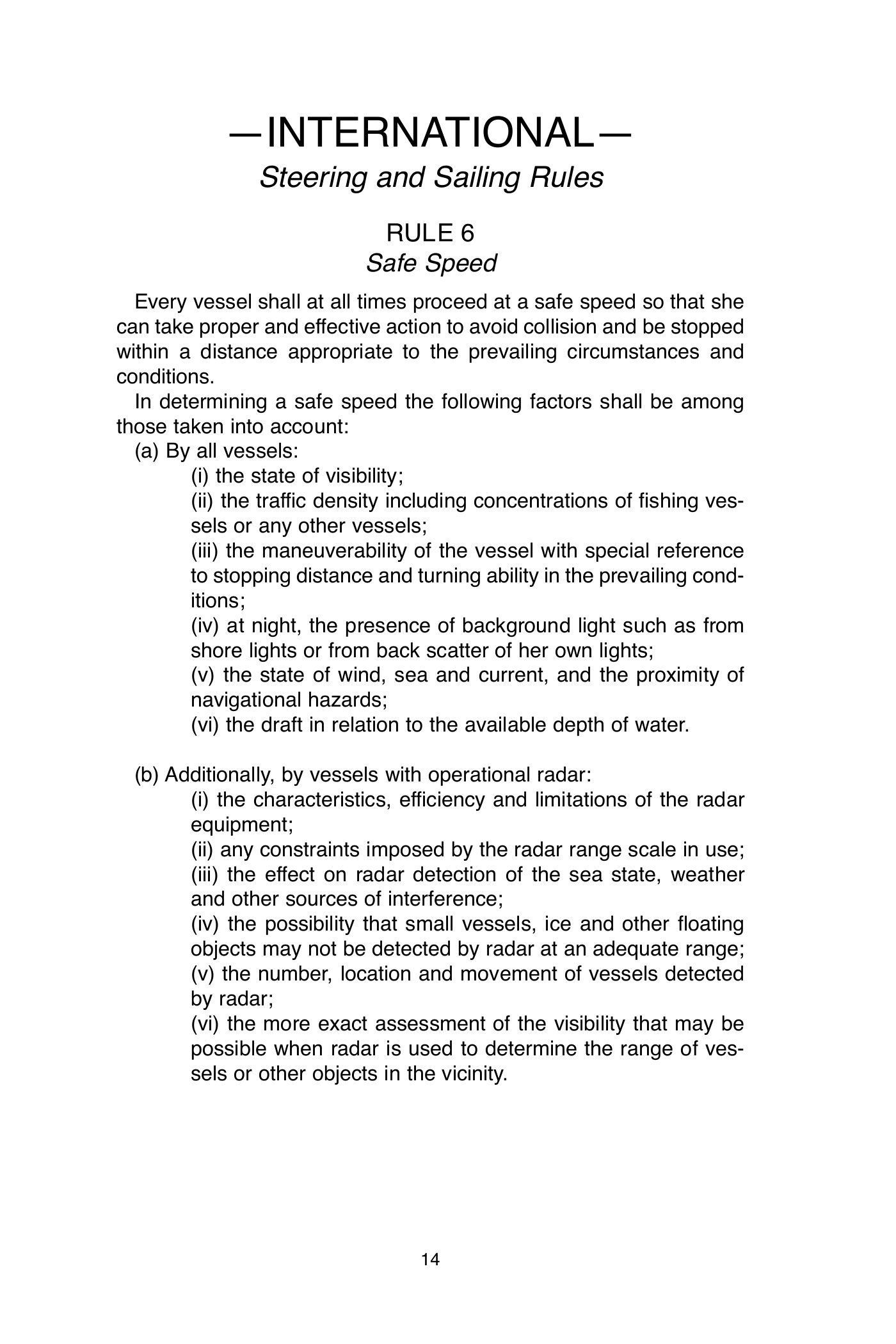
Every vessel shall at all times proceed at a safe speed so that she can take proper and effective action to avoid collision and be stopped within a distance appropriate to the prevailing circumstances and conditions.
Rule 6 then enumerates the factors. For any vessel: visibility, traffic density, vessel maneuverability/stopping distance, background light at night, wind/sea/current, draft vs. depth.
And explicitly for vessels with operational radar:
- (i) The characteristics, efficiency, and limitations of the radar.
- (ii) Constraints imposed by the range scale in use.
- (iii) Effect of sea state, weather, and interference on detection.
- (iv) The possibility that small vessels, ice, and other floating objects may not be detected at adequate range.
- (v) The number, location, and movement of vessels detected by radar.
- (vi) The more exact assessment of visibility possible when using radar to determine range.
The "small vessel" clause is the critical one for cruisers. A 35-ft fiberglass sloop without a corner reflector may not paint reliably on a 200-m container ship's radar until 1–2 nm — at 20 kt closing, that's 3–6 minutes. The rule explicitly says you must consider that some boats just aren't there on radar and adjust your speed accordingly. In dense traffic with mixed sizes, conservative speed is mandatory, not optional.
Show original rule page
Rule 7 · Risk of Collision
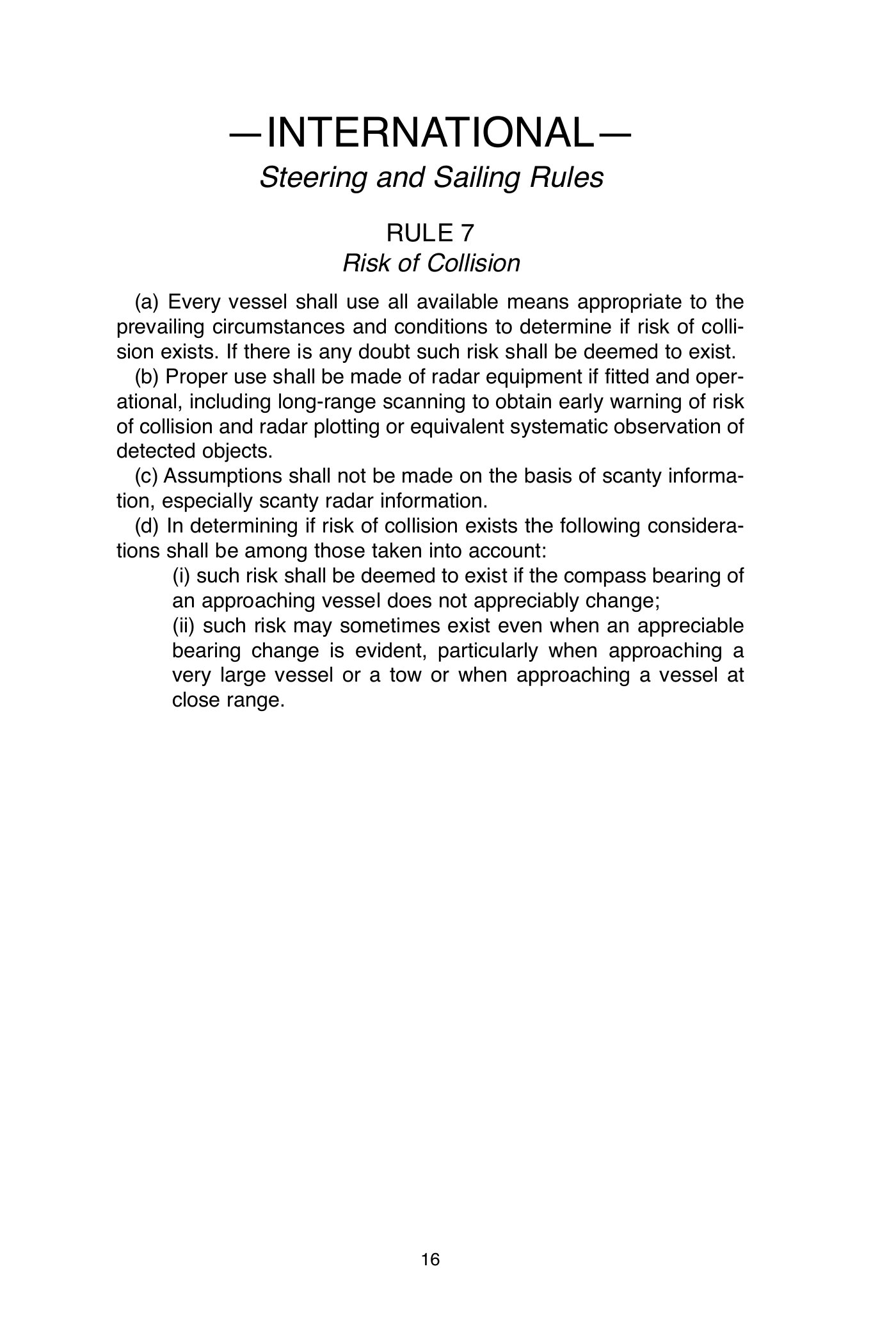
(a) Every vessel shall use all available means appropriate to the prevailing circumstances and conditions to determine if risk of collision exists. If there is any doubt such risk shall be deemed to exist.
(b) Proper use shall be made of radar equipment if fitted and operational, including long-range scanning to obtain early warning of risk of collision and radar plotting or equivalent systematic observation of detected objects.
(c) Assumptions shall not be made on the basis of scanty information, especially scanty radar information.
(d) In determining if risk of collision exists the following considerations shall be among those taken into account:
(i) such risk shall be deemed to exist if the compass bearing of an approaching vessel does not appreciably change;
(ii) such risk may sometimes exist even when an appreciable bearing change is evident, particularly when approaching a very large vessel or a tow or when approaching a vessel at close range.
Rule 7 is where radar plotting becomes legally mandated. "Radar plotting or equivalent systematic observation" means: it isn't enough to glance at the screen and decide vibes-wise whether you have a problem. You must take repeated, systematic observations and analyze them — exactly the procedure laid out on the Plotting and Collision Avoidance pages.
"Long-range scanning" means: don't sit on the 1.5 nm scale. Periodically zoom out to 12 or 24 nm so you see what's coming before it's a problem.
"Scanty radar information" is a phrase to live by. Two paints don't establish a track. A target that's been on screen for 2 minutes hasn't been observed long enough to predict. Don't act on inadequate data.
"Steady bearing = collision course" — Rule 7(d)(i) elevates this from a rule of thumb to a regulatory standard. If a target's bearing isn't changing as range decreases, the rule itself says risk of collision is to be presumed.
Show original rule page
Rule 8 · Action to Avoid Collision
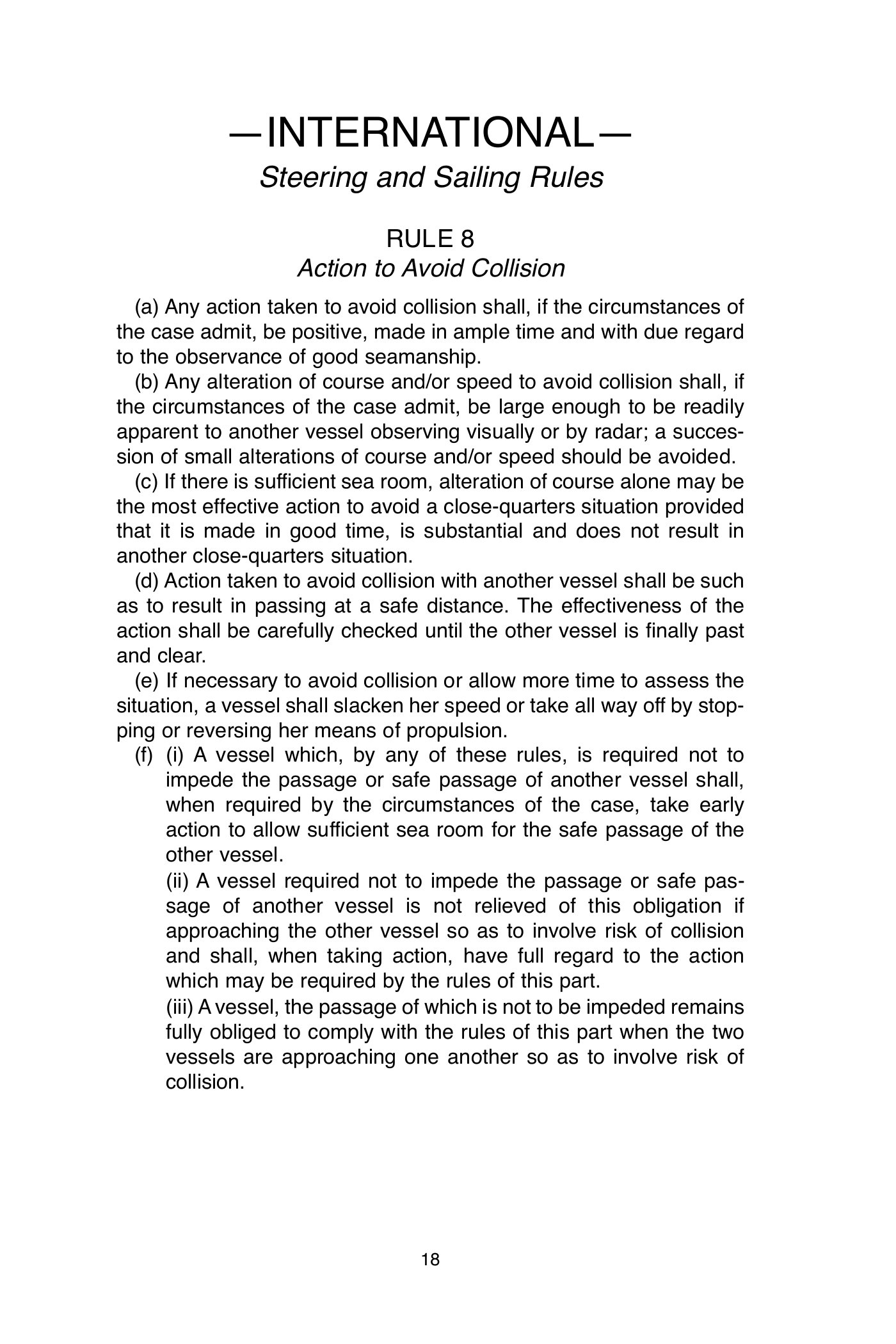
(a) Any action taken to avoid collision shall, if the circumstances of the case admit, be positive, made in ample time and with due regard to the observance of good seamanship.
(b) Any alteration of course and/or speed to avoid collision shall, if the circumstances of the case admit, be large enough to be readily apparent to another vessel observing visually or by radar; a succession of small alterations of course and/or speed should be avoided.
(c) If there is sufficient sea room, alteration of course alone may be the most effective action to avoid a close-quarters situation provided that it is made in good time, is substantial and does not result in another close-quarters situation.
(d) Action taken to avoid collision with another vessel shall be such as to result in passing at a safe distance. The effectiveness of the action shall be carefully checked until the other vessel is finally past and clear.
(e) If necessary to avoid collision or allow more time to assess the situation, a vessel shall slacken her speed or take all way off by stopping or reversing her means of propulsion.
The four rules-of-action embedded here, all radar-relevant:
- "Positive, ample time, good seamanship" — early and decisive. The textbook example: turn 30° away at 5 nm, not 5° away at 1 nm.
- "Large enough to be readily apparent ... a succession of small alterations should be avoided." The other ship is plotting you on their radar. A 5° turn over 6 minutes may not be detectable in the noise of their plot. A 25° turn is unambiguous. Make the maneuver visibly different.
- "Alteration of course alone may be the most effective" — provided you have sea room and it doesn't create a new problem. A turn opens up a lot more separation faster than a speed reduction at typical merchant-ship speeds.
- "Slacken her speed or take all way off ... stopping or reversing" — explicitly authorized as a collision-avoidance action. If you're confused or the situation is developing faster than you can analyze it, stop is a legal option. For sailboats this means heaving-to or rounding up; for power vessels it means reverse propulsion.
Show original rule page
Rule 19 · Conduct of Vessels in Restricted Visibility
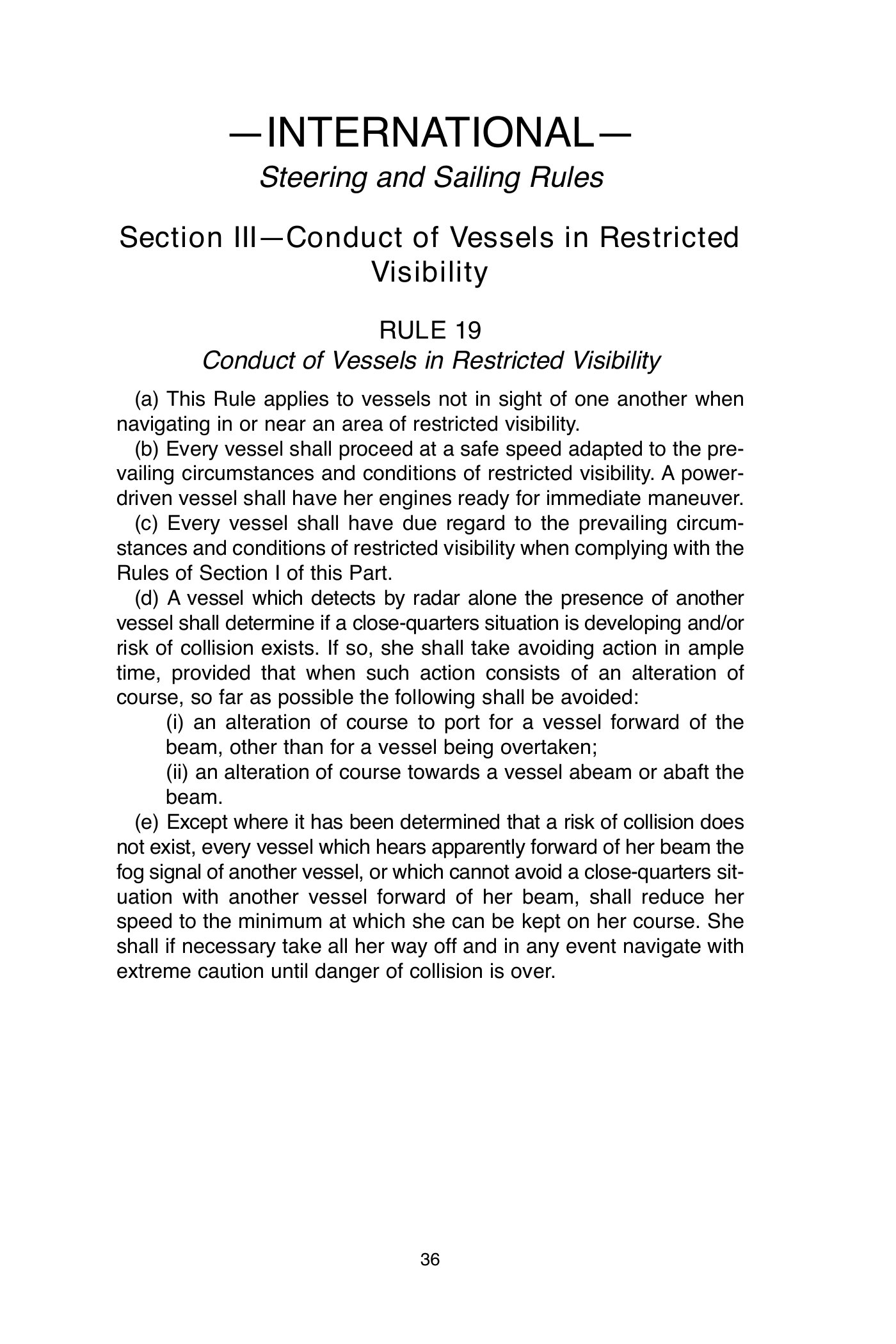
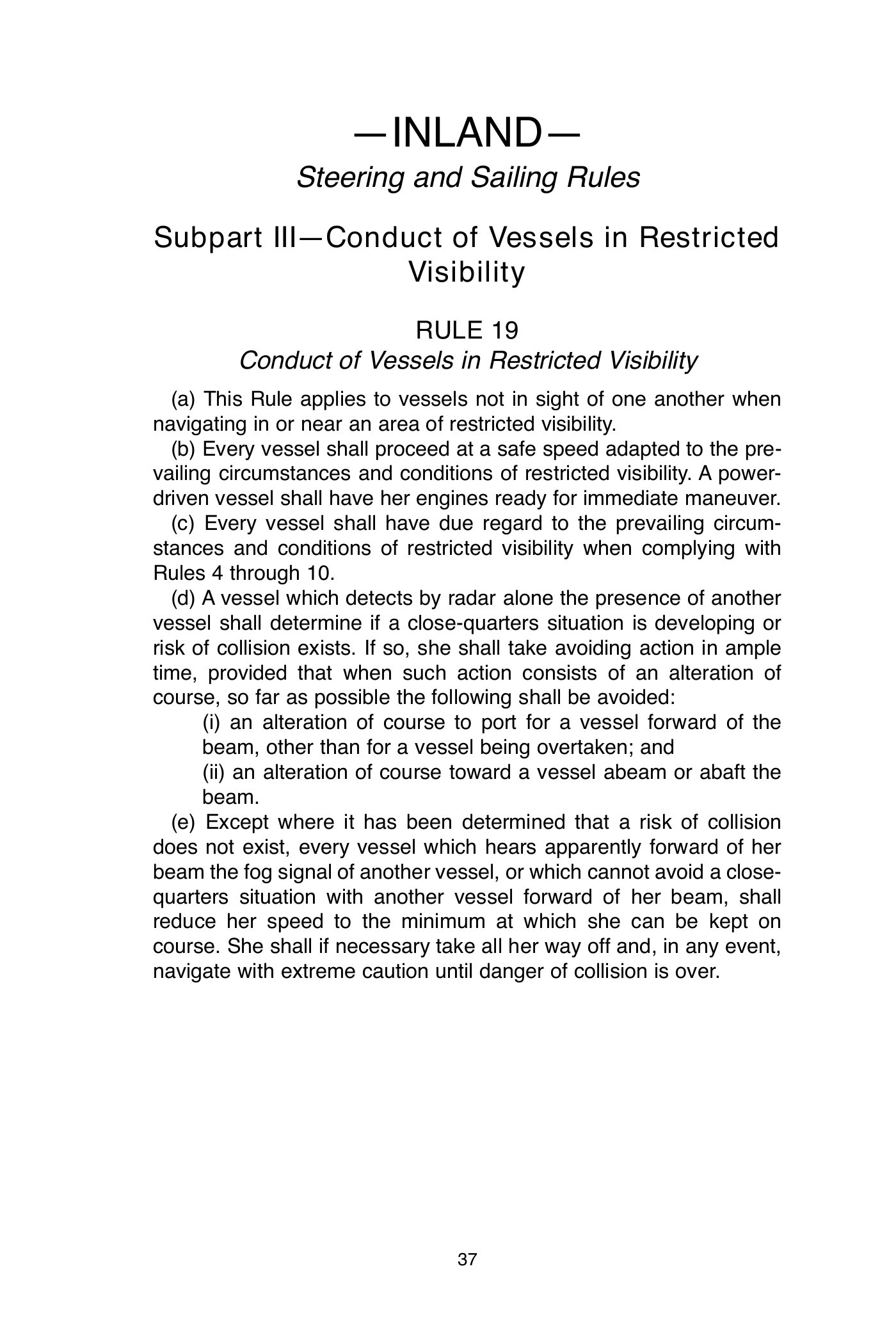
(a) This Rule applies to vessels not in sight of one another when navigating in or near an area of restricted visibility.
(b) Every vessel shall proceed at a safe speed adapted to the prevailing circumstances and conditions of restricted visibility. A power-driven vessel shall have her engines ready for immediate maneuver.
(c) Every vessel shall have due regard to the prevailing circumstances and conditions of restricted visibility when complying with the Rules of Section I of this Part.
(d) A vessel which detects by radar alone the presence of another vessel shall determine if a close-quarters situation is developing and/or risk of collision exists. If so, she shall take avoiding action in ample time, provided that when such action consists of an alteration of course, so far as possible the following shall be avoided:
(i) an alteration of course to port for a vessel forward of the beam, other than for a vessel being overtaken;
(ii) an alteration of course towards a vessel abeam or abaft the beam.
(e) Except where it has been determined that a risk of collision does not exist, every vessel which hears apparently forward of her beam the fog signal of another vessel, or which cannot avoid a close-quarters situation with another vessel forward of her beam, shall reduce her speed to the minimum at which she can be kept on her course. She shall if necessary take all her way off and in any event navigate with extreme caution until danger of collision is over.
Rule 19 is the special-procedure rule that takes over when vessels are not in sight of one another — fog, heavy rain, blizzards, dust storms. The "give-way / stand-on" framework of Rules 13–17 (overtaking, head-on, crossing) does not apply in restricted visibility. There is no stand-on vessel in fog.
The two course-change prohibitions in (d) are a memorize-this-or-die-trying piece of the rule:
- Don't turn to port for a vessel forward of the beam (unless overtaking). Turning to port would set up a head-on or fine-crossing geometry; you want to turn away.
- Don't turn toward a vessel abeam or abaft the beam. A vessel that's already passing you doesn't need you to maneuver into its path.
Combined with (e) — "reduce to minimum steerageway, take all way off if necessary" when fog signals are forward of the beam — Rule 19 effectively says: in fog, your default options are turn to starboard, slow down, or stop. That's it.
Show original rule page (international)
Show original rule page (US Inland)
Putting it together
The five rules form a coherent procedure for radar-equipped vessels:
- Rule 5 — turn the radar on; supplement (don't replace) visual look-out.
- Rule 6 — choose a speed that accounts for what your radar can and cannot detect.
- Rule 7 — long-range scan periodically; on any contact, plot or systematically observe before deciding; steady bearing = collision course.
- Rule 8 — when you act, act early, big, and visibly; check that the action worked.
- Rule 19 — in restricted visibility: turn to starboard, slow down, or stop; never to port for a forward target, never toward a target abeam.