
Radar Fundamentals
What's actually happening when the box paints a target. (Pub 1310 Ch.1)
1 · Pulse-modulated radar
A marine radar transmits brief pulses of microwave energy in a tight beam, then listens between pulses for echoes. The time between transmit and receive gives range; the antenna's aim at the moment of return gives bearing. Everything else is engineering around making those two measurements precise.
Five system constants set the radar's character:
- Carrier frequency — typically 9.4 GHz (X-band) or 3 GHz (S-band) on civilian vessels.
- Pulse repetition rate (PRR) — how many pulses per second; higher PRR limits maximum range but improves resolution.
- Pulse length — how long each pulse lasts; short pulses give better range resolution, long pulses give better detection of small targets.
- Peak power — how strong each pulse is; bigger sets push more power for longer range.
- Beam width — the angular spread of the antenna's main lobe; narrower beams give better bearing resolution.
2 · Components
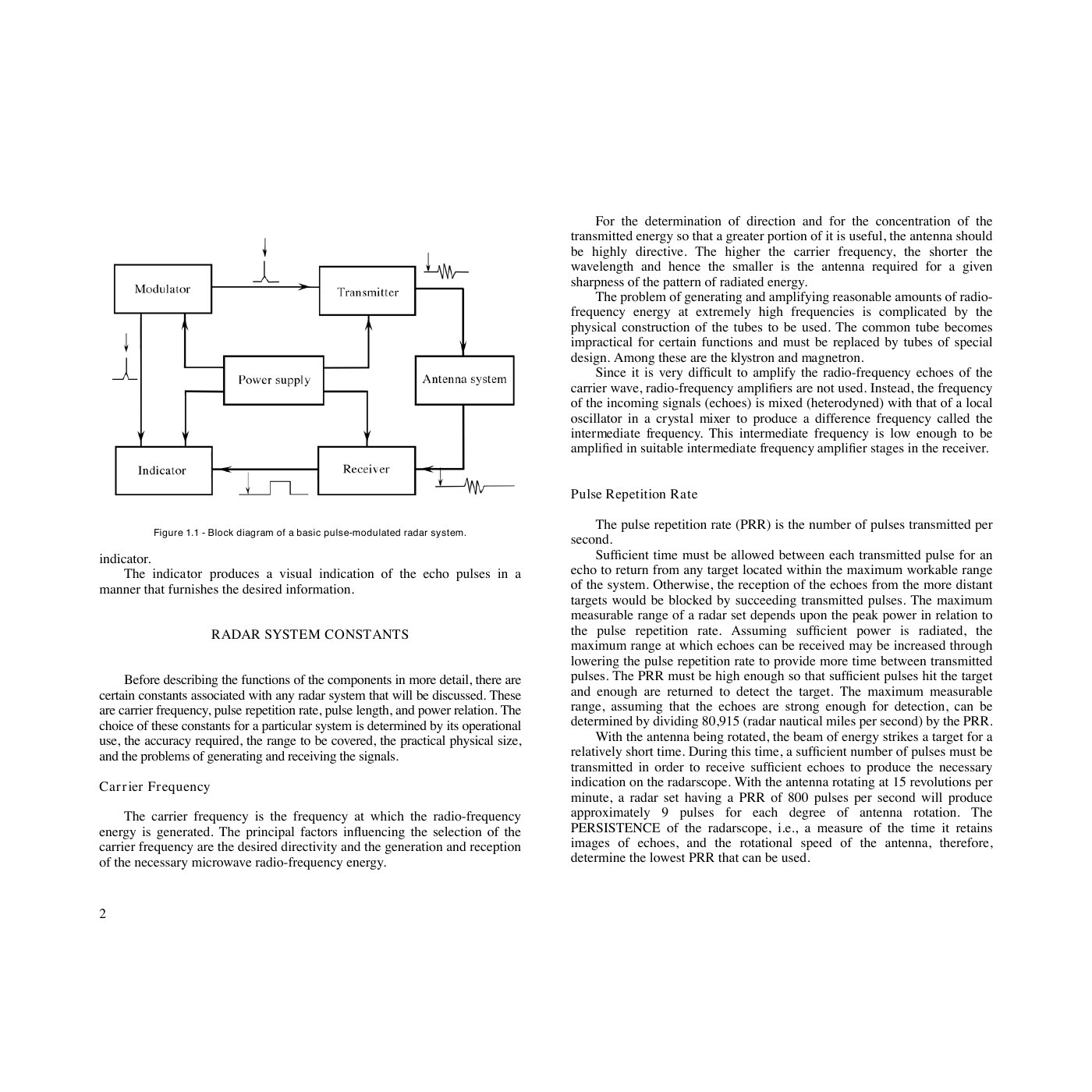
The standard block diagram has six pieces, all working in lockstep on a synchronized timing signal:
- Power supply — DC and AC for everything else. Marine sets are usually 24 V DC primary.
- Modulator — generates the timing pulses that key the transmitter on/off.
- Transmitter — produces the high-power microwave pulse (a magnetron or solid-state RF amplifier).
- Antenna system — radiates the pulse, then within microseconds the duplexer flips and routes returning echoes to the receiver. The slotted-waveguide array on top of your boat is doing both jobs.
- Receiver — amplifies the weak echo back to a useful voltage and detects the pulse envelope.
- Indicator — the screen, plus the trigger circuits that sweep the trace radially in sync with the antenna rotation.
3 · Propagation
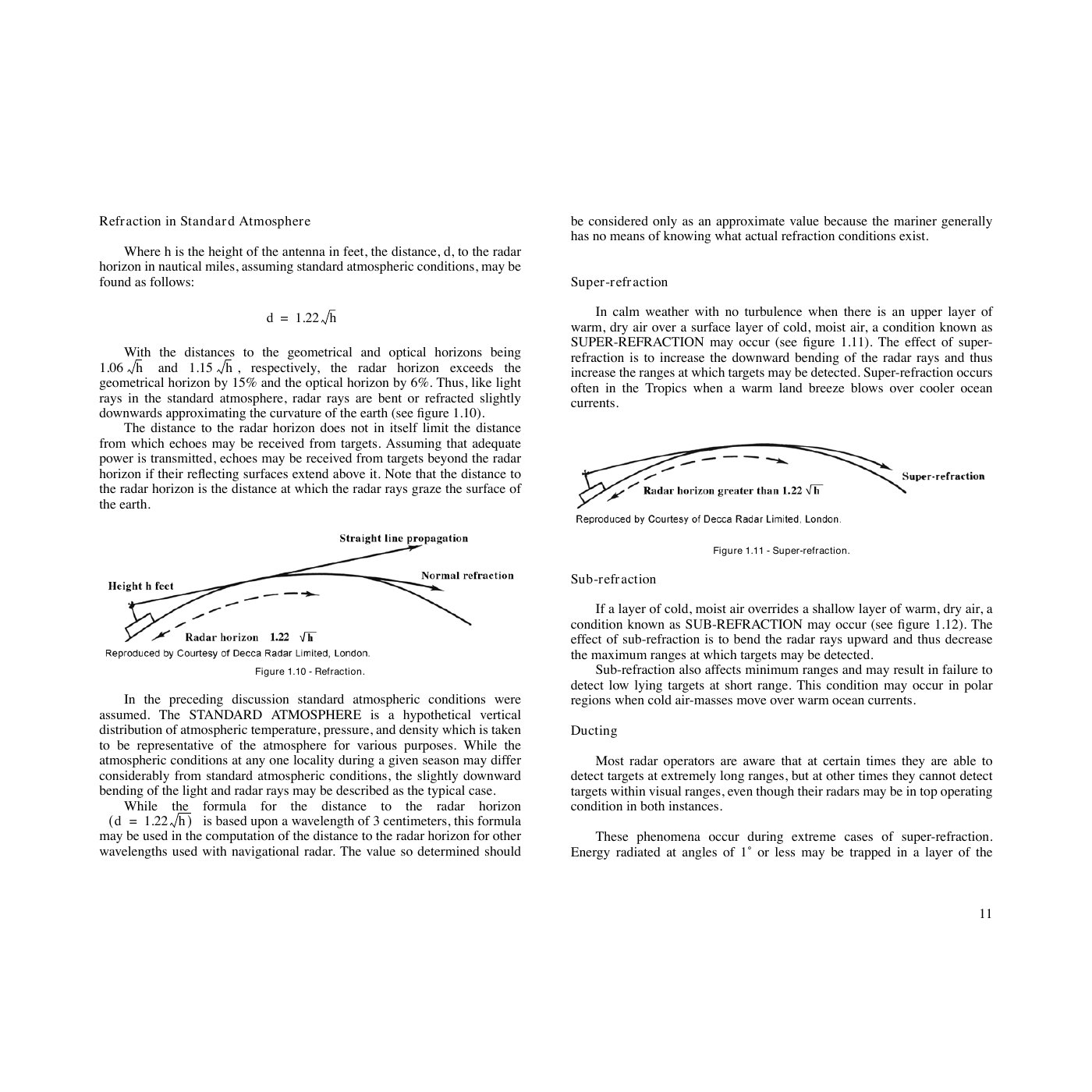
Radar waves bend slightly downward in the standard atmosphere (because the lower atmosphere is denser, the wave refracts toward the surface). This is why the radar horizon is roughly 1.22 × √(antenna_height_ft) nm — about 15% farther than the optical horizon for the same height. Super-refraction (warm dry air over cool water — a temperature inversion) bends the wave even more and extends range. Sub-refraction bends it less and shortens range.
Ducting is the dramatic case: a strong inversion traps the wave in a layer near the surface and lets it skip far past the geometric horizon. You'll see ships at 60+ nm in the duct, but you'll also miss closer targets above the duct layer. Common in light-wind subtropical highs.
4 · The beam
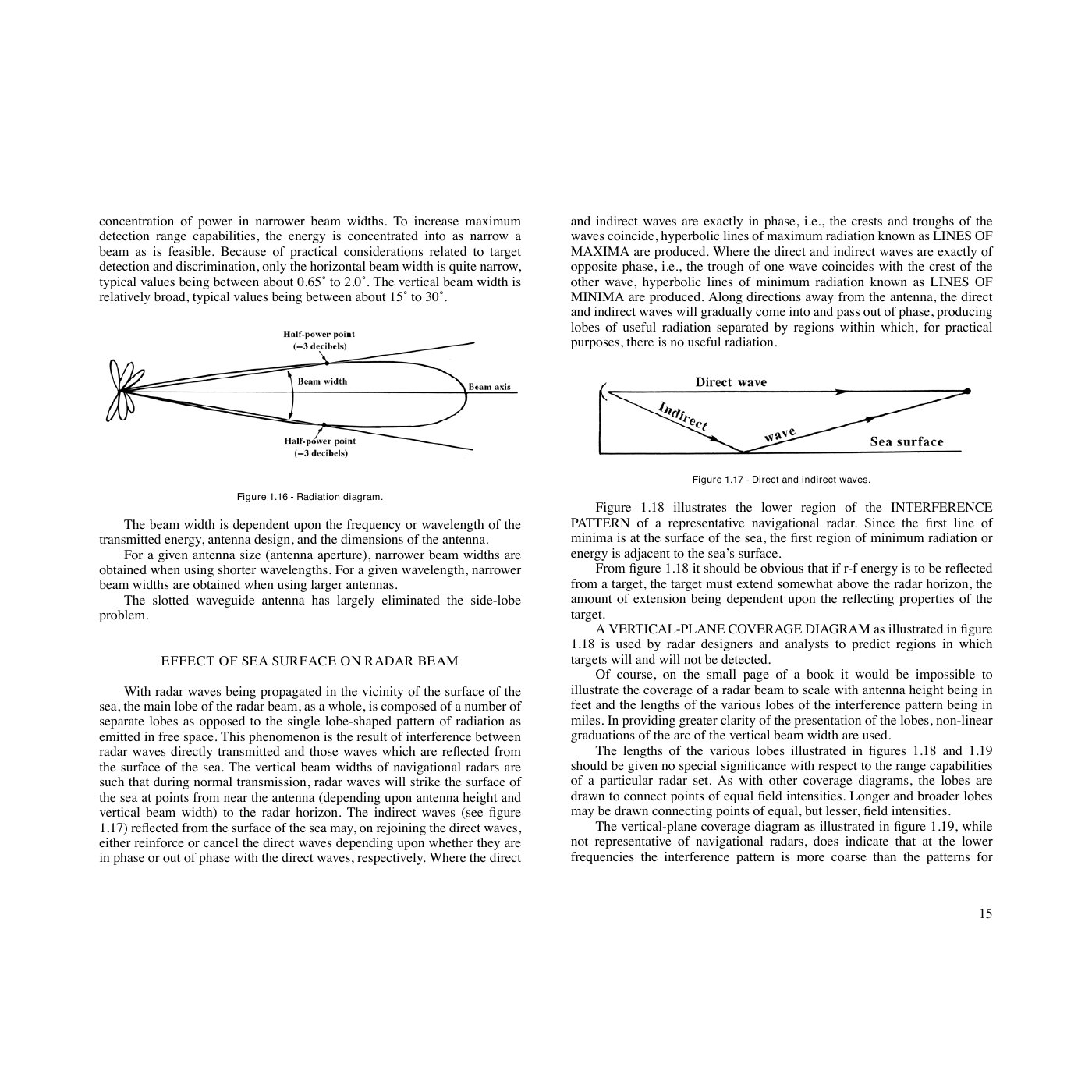
A marine antenna's beam is narrow horizontally (~1–2°) and broad vertically (~20–25°). The wide vertical fan tolerates pitch and roll without losing the picture; the narrow horizontal beam is what gives you usable bearing.
Sea reflection puts a nodal pattern on the beam: at certain elevation angles the direct ray and the surface-reflected ray combine to amplify the signal; at other angles they cancel. This is why a small target at the perfect range may suddenly disappear as your boat heaves.
5 · What makes a good (or bad) target
The same boat at the same range can paint as a strong blob or not at all depending on:
- Height — taller objects clear the radar horizon at longer range.
- Size — bigger reflective area returns more energy.
- Aspect — a ship broadside-on returns far more than the same ship bow-on.
- Shape — flat vertical surfaces (cliffs, large ship hulls) are excellent; rounded smooth objects (whale, calm-water buoy) are poor.
- Texture — corrugated steel paints brightly; fiberglass and wood return little.
- Composition — metal returns ~25× more than fiberglass at the same size. A small steel buoy outshines a large plastic skiff.
This is why a fiberglass cruiser without a corner reflector is genuinely invisible to many ships' radars at night, and why a passive corner reflector hoisted on the backstay is the cheapest navigation safety upgrade you can make.
6 · Weather effects
- Sea clutter — wind-built waves return strong echoes around your boat. Severity scales with wind, sea, and your antenna height. Mitigated with the STC (sensitivity time control) / sea-clutter knob, which suppresses gain in the close range.
- Rain — heavy rain reflects energy and absorbs it. A squall paints as a blob and hides whatever's behind it. Mitigated with the FTC (fast time constant) / rain-clutter switch, which differentiates the signal so only the leading edge of large echoes is shown.
- Wind — shouldn't affect the radar wave directly, but its spray and waves are what actually generate sea clutter.
- Anomalous propagation — ducting (above) gives spurious extreme-range targets that may not be where the screen says.
Practical takeaways
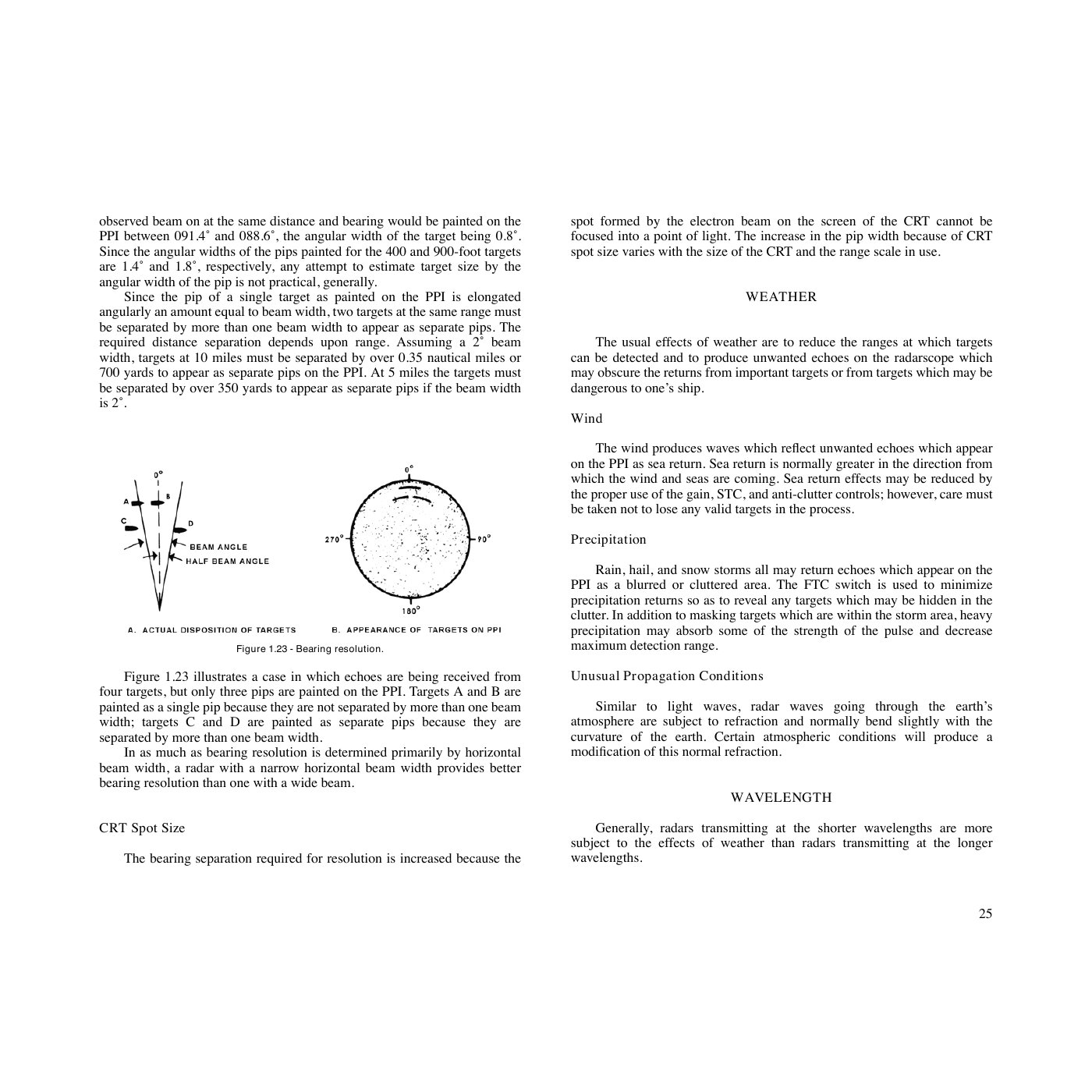
- Trust range more than bearing — bearing precision is limited by your beam width (1–2°), so a target painted "on the horizon" may actually be 1° to either side.
- An object that disappears as you bob isn't gone — it's at a vertical-pattern null. It will reappear.
- If your set seems "blind" inshore, suspect STC; if it's hiding things behind rain, FTC. Both are tunable.
- Carry a corner reflector. The radar that protects you is the one on the freighter, not your own.